

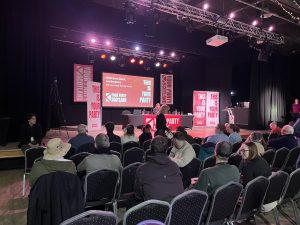
Delegates voting at NEU conference 2019
NEU battles ahead – report from NEU conference
rs21 members •The first NEU conference set an ambitious course for boycotts and strikes over primary school testing, funding and pay, report rs21 delegates.
This year’s conference was the first for the new amalgamated union and this added to a sometimes-palpable sense of novelty and potential. The other factor was Corbynism. It wasn’t just the anticipated and, by now expected, rapturous welcome for Corbyn’s appearance that did it, it was the sense that some of the long fights – against SATs, academisation, etc, – now had a political expression and the chance of a friendly government (for the first time in four decades) that could help solve them. With a general election lurking around every corner, there was a feeling that the times were a-changing.
Some of this spirit manifested itself at conference as impatience. The debates around recognition for support staff and on the primary testing boycott contested the carefully constructed strategy of the Executive in these areas and let to a sometimes-volatile Conference. Regarding the former, while the NUT only recruited qualified teachers, the merged union has followed ATL practice in allowing other education workers to join. But support staff numbers are still a fraction of those represented by GMB, Unison and Unite, so the proposal to push for collective bargaining rights with the TUC was considered premature. Although the frustration of some members about this approach was understandable, others argued that bottom-up organising combined with united action with other unions remained key.
But the impatience displayed in such debates was coupled with an inspiring optimism. On conference floor, there was a real feeling that the future direction of education was up for grabs. As the Tories decay over Brexit and Labour takes the lead in the polls, it suddenly feels like teachers can glimpse a light at the end of a long neoliberal tunnel. This mood was best summed up by the conference’s commitment to developing a National Education Service, abolishing Academies, exploring alternatives to GCSEs and boycotting high-stakes testing in primary schools.
Despite Corbyn’s popularity, a proposal to investigate the use of the political fund to sponsor sympathetic MPs – and potentially affiliation to Labour – was defeated by a combination of left- and right-wing opposition. The former grouping feared being bound to a reformist party that had betrayed so many hopes in the past, the latter invoked the need to remain ‘apolitical’. But on two key current political issues delegates nailed their colours to the mast; we rejected the false equivalence of oppressor and oppressed suggested by one speech urging neutrality on Palestine, passing instead a policy of solidarity and support for the Boycott, Divestment, Sanctions campaign. And we offered full support for the aims of the student climate change strikers.
Delegates also agreed an important urgent motion on the controversy around No Outsiders at Parkfield School and elsewhere in Birmingham and Manchester. We reaffirmed our belief that all children are entitled to age-appropriate Relationship and Sex Education (RSE), that the erasure of LGBTQ+ lives demanded by some bigoted voices is completely unacceptable. The motion also recognised the danger that coverage of the dispute was being used by some to fuel Islamophobia, and the damaging role that Prevent played in this.
Boycott of primary tests
Conference passed an important policy on boycotting primary school testing. This means not administering or preparing children for the SATs, the Year 1 phonics screenings or the Year 4 timetables tests, as well as reaffirming our opposition to the introduction of baseline tests for 4-year olds. This is a big ask but with the Greens, Lib Dems and, most importantly, Labour all committed to scrapping SATs, we now have the opportunity to do away with these hated standardised tests. The tests narrow the curriculum, destroy educational opportunities and leave children stressed and anxious – they need to see the inside of the dustbin.
Organising a boycott in primary schools is going to take a lot of work for NEU activists and it needs to start now. The first hurdle will be overcoming the balloting turnout thresholds created by the Tories in 2016. This proved too high for the recent funding ballot but we need to draw on that experience and the information it provided about our organisational strengths and weaknesses.
For parents and supporters, it’s time for you to start raising the issue at the school gates and putting pressure on your local Headteacher to support the boycott.
What can you do?
NEU Activists:
- Agree an action plan in your districts as soon as possible.
- Gather reps, ring round all of your members and get them to meetings in the week commencing 20 May, ahead of the indicative ballot on 4 June.
Parents and supporters:
- Use the ‘More than a score’ material here to approach teachers and Headteachers to start the discussion around the boycott.
- Build the ‘March of the Four Year Olds’ this Thursday 25th
Balloting for strike action on pay and funding
Teaching is in crisis – thousands of teachers leave the profession every year citing stress and workload as the main factor. This is inextricably linked to funding pressure (leading to larger class sizes and greater pressure at work) and poor pay. The NEU also committed to balloting school teachers next academic year on pay (and 6th form teachers in the next few weeks). As our zombie government lumbers on, this could lead to an impressive national strike next Spring that might finally bury the Tories. The campaign around pay and workload is connected to wider arguments about transforming education – it has a chance to build a transformative agenda around a new social democratic settlement for public services. It can win in its own sectional interests but it can also provide a clear push to the new Corbynista Labour party to deliver.
What can you do?
NEU Activists:
- Now is the time to work on your membership records and start the discussion on funding, pay and workload. The issues are linked.
- Why not do a stall or leaflet parents with the School Cuts materials around the upcoming local elections? This can help lay the basis for future work on the pay ballot.
- Get 6th form college speakers to your school and district meetings and raise money for a hardship fund – they are planning several days of unpaid action and need your support.
Parents and supporters:
- Use the School Cuts materials around the upcoming local elections to challenge candidates on school funding in your local area. Why not leaflet your school gates to spread the word?
- Get involved in campaigns such as SEND National Crisis, who are marching on 30 May, highlighting the especially damaging impact of the cuts on students with special needs and disabilities.






2 comments
The testing boycott in Primary was promoted enthusiastically by the AWL, as was fight for equal rights inside the union for non teaching staff.
The SWP, vociferously opposed both, taking key speeches on behalf of the union leadership. I think the SWP’s line was and is a disgrace.
But what do you think. You don’t say which way you voted.
Any chance of a response?