

Your Party founding conference: reflections and tasks
Andy C •rs21 members attended the inaugural Your Party conference. Andy C reflects on the conference and the future of Your Party. We will be posting more reflections in the coming weeks.
It is our party
I went into the Founding Conference worried that this project was going to founder on the rocks; I came out of it feeling positive. There is a real potential here to build the sort of tool we need to advance the class struggle in Britain. I want to reflect on some of the specific issues further down but I as I drove back across the Lancashire plain from Liverpool, I did have a sense that this was our party now.
The response to the bureaucrats
The first five months of Your Party has suffered from various bureaucratic ruptures. They have been frustrating and they have damaged the Party – gone are the enthusiastic newbies of August. This infighting has been of a peculiarly reformist nature – driven by egos much more than politics. But I have always maintained that it wouldn’t survive contact with the real world and that was the case. The key defeat for Royal Court of King Corbyn was the victory of the collective leadership option. This gives us a good basis for building a better political culture going forward.
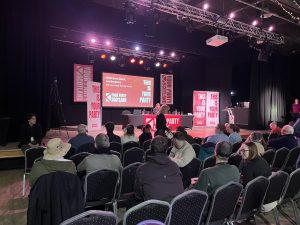
It should also be remarked upon just how incompetent the people around Corbyn are at running a Conference. The set-up in Liverpool was amateurish, inaccessible and needlessly fractious. That basic political incompetence extends to the ridiculous comms ‘strategy’ that Your Party has employed so far. There needs to be a clear out of the also-rans of Corbyn’s Labour years so that we can get some competent people in post – he seems to value personal loyalty over political competency but I’m not sure anyone else in the membership agrees.
The divisions in Liverpool
There was lots of talk of factions and some frankly McCarthyite nonsense about left groups before and during the Conference. These weren’t the key divisions though, as the Dual Carding vote makes clear. Instead, I think there were two key divisions in Liverpool, and neither were particularly delineated by the low-quality of debates.
The first division was between those delegates, whatever their politics, who had come from active proto-branches. Their engagement was sharper, their politics more thoughtful and their interventions more knowledgeable. They had had some of these debates in their Branches and had had some experience of working with others in the Party. Their contribution contrasted with those who had been randomly sortitioned from the email list – no such political education existed there, and their contributions were often full of basic assumption errors. This isn’t their fault, but it does show that, even within our activists, we have a real job of work to do around education: what does socialism mean? What is the working class? Why do we have a party? What is the state? Simple questions that people need guiding through.
The other key division is one I am both more comfortable with and more strident in arguing against. In summary, this is the division between those who are looking for an electoral grouping and those who want to build working class power. For the electoralists, this is a new Labour but without the nasties. They want everything to be nice and they think that capturing electoral power will deliver this. Anything that hinders that goal is therefore bad: arguing against oppression, calling ourselves socialists, focussing on the working class, talking about Gaza, calling Reform racists all become problematic because they are a point of tension and disagreement that might harm our electoral chances. This is Blairite triangulation under a new name, and it has two effects (i) by treating people as fixed in their opinions, it ends up strengthening right wing ideas and (ii) it demobilises our activists by pretending that other people can win a better world for them. There was a huge overlap between this group and the cult of Corbyn at Liverpool they see Corbyn as someone who can do it for them. Now, this group is mistaken, and we need to do some work to turn them into activists but they do have a place in a radical left alliance party, like the one we are trying to build. I want to keep them but those on the left of the party do need to start articulating and clarifying this division if we’re going to get anywhere.
Partly, this is because the alternative to the electoralists is both simultaneously more exciting and more realistic. The electoral path to working class emancipation has failed every time and everywhere. The alternative, building working class power, offers a way of really transforming society. In the coming months, that is what we have to focus on: how do we build working class identity? How do we develop working class power? How do we encourage the confidence to wield that power to make real gains? These are the key questions that need to be discussed in our branches as we get on with the tasks of organising this new party.
Immediate next steps
We need to grasp the opportunities following Liverpool to launch and relaunch our branches. There needs to be a focus on education, but this has to be done within the context of a branch that is active and that has a positive internal culture – joint activity will make sharp political discussions easier and a positive political culture will help to encourage engagement and activity. So start a branch if you don’t have one – if you do, take your branch out onto the streets



0 comments