

How Italian dockers disrupted the Israeli war machine
Tomasso •We interviewed Tomasso, an Italian member of the French group Révolution Permanente, about the wave of political strikes in Italy, and the refusal by dockers to work on ships carrying goods from or bound for Israel.
The video covers Tomasso’s introduction and an overview and chronology of the strikes.
After Tomasso’s introduction we asked him to talk more about some specific features of the dockers’ actions and the wider movement.
rs21: You speak about 20 to 25 years where we haven’t seen this level of activity. What kinds of politicisation have been happening in the past weeks? How have actions managed to be organised on this scale in Italy?
I think it’s an interesting question that doesn’t have one clear answer. There’s an element, where, basically, there are certain bastions of the trade unions and the working class in Italy that have remained combative and anti-imperialist over the years. I think the port workers are an example of this. When I was in Genoa, one thing that kept coming up every time I spoke to a docker or port worker was the fact that when a new person was hired and started working, there would be someone from the trade union who would come and explain to them how things were done, that they don’t just go on strike for for their wages or for their working conditions, but also for very political issues. It’s something that started in the 1970s. You would hear dock workers telling you about the guy who told them when they arrived, and then other dock workers telling you about what they tell now to the young guys and girls who start work at the dock.
Then the question of Palestine. I think we see this all over Europe. Globally there is disgust and revulsion at what’s happening in Palestine, and the question is not so much how do we make people understand what’s happening in Palestine. We are, in part, beyond that question now. So the question is more like, why haven’t people been mobilising as much as we want. I think there’s a kind of demoralisation, organised by states, and the fact that the dockers, by going on strike, stopped the shipping of weapons to Israel, showed much broader sectors of the population that we aren’t powerless, that we can mobilise on this.
rs21: So there’s a sense that there’s been a latent desire among the population to do something. You mentioned the CGIL falling in behind the USB. Did the other unions do the same – or was it more like spontaneous action?
Italian trade unionism is basically separated quite clearly between the unions who negotiate with the government and with management, and those who, instead, have more of a tradition of strikes and mobilisation. The CGIL (Italian General Confederation of Labour) is generally the more left wing union of the ones who negotiate with bosses and the government, with maybe a more left wing base. And it’s also by far the biggest union in Italy (with over 5 million members, 2.7 million in employment). In general, there are higher expectations for them to mobilise, and especially when for the past year or so, their leadership has been saying how shocked and revolted they were about what’s happening in Palestine, and then doing absolutely nothing about it.
I don’t think there was as much pressure in other unions to call these strikes – they position themselves as very ‘apolitical’ unions, while the CGIL has, at least in their discourse, a little bit more anti-fascist rhetoric It was one of the unions that combatted fascism in Italy historically. The few times they have declared national strikes or mobilisations, they actually haven’t mobilised that many people because their base sees that these mobilisations are not organised by the base, and the dates are kind imposed from the top down and they are almost symbolic mobilisations, after which the CGIL will go and negotiate with the state and with management.
It’s interesting that there were a lot of CGIL members on strike for the very first time on the 22 September, and it wasn’t even called by their unions. It’s worth losing a day’s pay to go on strike, while the other strikes called by the CGIL in the past were purely symbolic.
rs21: It feels like quite a big step to lose a day’s pay on something that isn’t necessarily going to materially benefit you.
Yeah – I don’t have a definitive answer to why 2 million people went on strike. I think the paradoxical thing is that there wasn’t an incredible amount of grassroots organisation in workplaces. To take an anecdotal example, my aunt works in public services – the equivalent of the civil service, but at a regional level, it’s an office job. And she’s a trade union member in the CGIL union and she’s never gone on strike. She told me over Christmas that she’s a trade union member because they help her do her taxes once a year. It’s not like anyone’s talked to her from the USB (Unione Sindacale di Base) (as Tommaso describes in the video introduction above, this is the smaller, more radical union who initially called the general strike) – but she’s disgusted about what’s happening in Palestine. I think there is an element where it is a bit spontaneous, seeing the demonstration that the dockers did, and the fact that even before the strike, the dockers had stopped weapons shipments to Israel, be it by strikes or other means.
rs21: Is the long running GKN factory occupation in Florence a precursor to the recent events?
It’s a good question. GKN is a factory in the outskirts of Florence that has been threatened with closure, and it was occupied by the workers. It’s a struggle that’s been going on now for three years. GKN became a gathering point for the entire Italian radical left and trade unionism, and I think it remained a thing that was the best of the radical left. The precursor to a lot of these mobilisations on Palestine was in the student movement, part of the global wave of student solidarity from the US to Britain, to here in France, and in Italy as well. In Italy there is a real anti-imperialist generation that has been formed over these past two years of genocide.
This is not the first time we are seeing occupations or demonstrations from students on the question of Palestine but we’re now seeing them on a much larger scale. There were periods in the past few weeks where you could look at every major city in Italy and their university was occupied by students.

rs21: What’s been the response from Meloni, and how have events affected her support?
One part of the mobilisation sees Meloni as just one amongst several imperialist leaders, and the embodiment of Italian imperialism. But it’s not just Meloni, because it’s also Starmer, Macron and Trump. Which to me is something that’s quite progressive. It shows a deeper understanding of what imperialism is, and it shows that a centrist head of state in Italy would also be supporting the genocide. There’s been a second wave of reactions because, as you can imagine, Meloni did not support the strikes. She, as well as many of her ministers, made denigrating comments against the strikers and the mobilisation. For example, they said that trade unions should be fighting for wages and working conditions, not on political questions. There was outrage at this.
Meloni and her government have been forced to respond in a hypocritical way to some of the mobilisations. For example, the Italian Ministry of Defence sent two Navy ships to ‘escort’ the flotilla and to guarantee its safety. One day later the military said that the Navy ships would not be entering the zone in which previous flotillas were intercepted. Everyone understood quite quickly that ships were there to try to convince the Italians aboard the flotilla to come back to Italy. The Italian Minister of Defence said this word for word at one point. There is this understanding, which again, is super progressive in the movement, that Meloni will not stop supporting the state of Israel. Even when you hear the slogans that are chanted in protest, they demand very little from Meloni. They are about organising to stop the weapons shipments, stop everything and put an end to the genocide. They understand that this is the minimum that’s required to put imperialist forces on the defensive. At the same time, Meloni was forced to suspend a license for a weapon produced in Italy by the arms manufacturer, Leonardo. Italy is the third biggest arms supplier to Israel.
There was an immediate willingness from the dockers to organise internationally. Now they have made a joint declaration with dockers around Europe and the Mediterranean, that calls for a common day of mobilisation, against militarism and against the genocide. When I was in Genoa there was an international conference of dockers. There was a deep consciousness of how key their role is in European logistics. If they all mobilised collectively, they would be able to put a real dent in the war machine.
Even on the days where there aren’t strikes, there is often, it depends port by port, a refusal to unload or load ships that are coming from or going to the state of Israel. One of the dockers from France at the conference was telling me that now there is much more coordination amongst trade unions in different ports. Before, the Italian dockers would refuse to unload a ship, but the ships would just go to another port in the Mediterranean and unload there. Now they call each other and say, ‘Hey, we’ve just refused to unload the ship. It’s probably coming to you, don’t unload it.’ They came out of this conference with a common political position: talking about how governments are leading us to war, how this is cutting budgets in education and in health, talking about the colonisation that the Palestinian people have been suffering since before 2023.
On the question of the ceasefire, time will tell – it’s in no way stable and also a plan of pure colonisation of Gaza. It is in no way a progressive outcome of this genocide. And I think this is understood in the movement.
rs21: So arms shipments are being blocked outside of strike days? How are workers determining what’s in the containers?
Yes, arms shipments are getting blocked, including on non-strike days. To give a concrete example from when I was in Genoa, one of the evenings there was this big protest with 50,000 people on the streets. At one point, I see a group of people leaving the protest led by a group of dockers with their trade union hoodies on, heading towards the port. And then later on, someone says that they had got word that there was a ship coming in that was going to unload and load some things and then head off to Israel. So they stopped the ship from unloading. I think it’s interesting when you compare how we try to do it as non-dockworkers compared to how the workers do it. They’re actually doing much less research because they know where each ship is coming from and where it’s going. The rule they have now is that if a ship is going to Israel, and they don’t know what’s contained in the ship, they will not unload it or load it until they check what’s on it. And once again, if they don’t unload it or load it, no one else is able to.
rs21: Can you say something about the geographical spread of the actions?
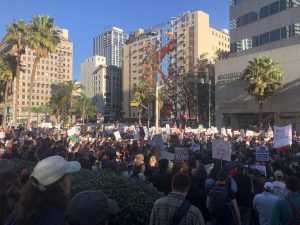
Yeah – as I’ve been following this, I’ve discovered a bunch of new cities in Italy because small and medium-sized cities had truly massive demonstrations! In Padua, which is a small city, one in four people were protesting on 3 October. And in Genoa, when I was there, there was a protest in the evening and there were 50,000 people on the streets – one in 28 people were out on the street. On the one hand you have actions in the north of Italy, where in the 1970s trade unionism was the strongest, where the Communist Party (PCI) would have the highest results at elections. But what’s interesting is that this is huge all over Italy. Every port in Italy mobilised. It starts in Genoa, but it’s also ports in the very south of Italy and on the outskirts of Rome, Naples, Livorno, and Ravenna. In cities where there aren’t ports or big industrial centres, the universities have become the heart of the movement.
Around Europe the mobilisations in solidarity with Palestine in recent weeks have been influenced by the dockers’ actions. So I think it is already being a catalyst for other movements. And it’s interesting that this happens with a media blackout on this in the rest of Europe.
rs21: What do you make of the contrast between what’s happened in Britain, with huge demos sustained over two years but little workplace action, and what has happened in Italy? How do you sustain this momentum?
Britain has had huge mobilisations and some of the biggest in the world on Palestine. I do think this also shows the role that trade unions have to play and that trade union leadership has to play. I think there’s a real lesson here to be learned from this movement, which is the fact that radical actions work when they are massive and massively supported. And so the reason why very few people were arrested is because you can’t arrest hundreds of thousands of people blocking motorways.
How can this movement keep going? I think there’s a clear answer which is that it needs to stay controlled by the base. This links to the questions being asked about general assemblies. There need to be more general assemblies that decide what it’s calling for and the mode of action. The CGIL has now put out a new date of mobilisation, which is so far into the future that it’s ridiculous. It’s the opposite of the logic that we should have which is, you grow the movement by having consistent action and not letting it die down. I think there’s a second element, and it’s that this movement is starting to have to be clearly against Meloni. There is an element of this movement where it can become the major force of opposition against Meloni and go beyond the question of Palestine. It’s interesting because often when we talk about the slow death of trade unionism in European countries, there is this idea that trade unionism needs to be started again or reinvigorated by talking about the most local issues possible. First you need to talk about your colleagues’ paycheque, and then eventually when you have a solid enough base, you can maybe start talking about things against the government. I think this movement has demonstrated the opposite, and the working class isn’t just politicised on the questions of pay. And so in a moment where Italian trade unionism was one of the weakest in Europe we’re seeing it at the forefront of mobilisations in the world. It shows how there’s a different way to rebuild and reinvigorate trade unionism, and that it can come from questions that are actually incredibly radical and incredibly political.
Show solidarity with these unprecedented strikes – contribute to the dockers’ strike fund here





0 comments