

Interview | Behind the Zohran Mamdani campaign
Samuel Kelly •Zohran Mamdani’s win in the Democratic primary for New York mayor demonstrates the strength of organised socialist campaigning. Samuel Kelly speaks with NYC-DSA organisers about the work that made it possible.
In June, a socialist named Zohran Mamdani won the Democratic primary for New York mayor. By beating the corporate funded Cuomo, Mamdani surpassed many expectations, even on the left. Mamdani is young (especially for a politician in the US), he is a Muslim, and he is a socialist: people like this aren’t supposed to win elections in the US. Least of all in the wake of the Democratic Party’s collapse and Donald Trump’s violent return to the White House.
Mamdani’s victory was all but confirmed in the early hours of a Wednesday morning in June. A month later, on a Thursday evening in July, Zarah Sultana announced she would be co-leading a new leftwing party in Britain with Jeremy Corbyn. Depending on who you ask, this announcement represented a long overdue step forward in a grinding process or a starting gun snatched by someone who hadn’t received permission to start firing in the first place.
Sultana’s announcement sent backroom organisers into crisis management mode, it sent hundreds of thousands to a sign-up page for an as-yet-undefined party formation, and only now in September do we finally have details about what the founding process will involve. In the interim Your Party has been defined by secrecy, gossip, and an eagerness for leadership to move beyond the phase of closed-room negotiating.
It’s hard not to feel like there has been a failure to capitalise on the consistency between these two events. Speaking on The Dig podcast, labour historian and writer, Gabriel Winant explains how Mamdani’s win ‘completely buries the idea that the cycle of political and social upheaval kicked off by the 2008 financial crisis and playing out through Occupy, through Black Lives Matter, through Bernie… is in some way over. I think now we can see really clearly [that] this is continuous with that phenomenon.’ Similarly, Your Party in Britain could yet prove that Corbyn’s leadership of the Labour Party might have been the first attempt, not the death knell, for a socialist project born out of the post-crash anti-austerity movement.
Zarah Sultana did take part in a one-off event with the Democratic Socialists of America (DSA) during her unusually-timed trip to the US. But importantly, it is at the grassroots where organisers in Britain have started looking to their transatlantic counterparts for direction. This westward glance has been tinged with envy, mainly for a broad, grassroots and multi-tendency socialist organisation that has been able to grow its membership whilst making inroads into the electoral arena. Against a backdrop of Your Party’s machinations, network-left maneuvering and an organising landscape defined by sects and factionalism, it is quite understandable that many here would look to the success of NYC-DSA and ask: why can’t we have something like that?
As much as commentators have tried to credit Mamadani’s policy package, media strategy or focused messaging for his victory, all of these are downstream from a radically different context within which socialists are able to organise. If we want to make accurate assessments of Zohran Mamdani’s victory and learn what can (and cannot) be replicated from the success of NYC-DSA, we need far more direct correspondence between socialists in both places (not to mention many other parts of the world). With that in mind, I reached out to Elizabeth Oh and Leon Delaney, members of DSA-NYC, with some questions about the longer-term organising efforts which made Mamdani possible in the first place.
Samuel Kelly: With Zohran’s win, many on the British left are reflecting on the successes of the campaign and what could be replicated here. Much of this reflection has focused on recent developments and the campaign specifically. But what are the longer-term organising practices that DSA have been involved in that have meant that a campaign like this is even possible?
Lizzy and Leon: NYC-DSA has been running winning campaigns for socialist candidates in city and state elections since 2018, when we won our first state senate race. Today, we have 12 endorsed ‘socialists in office’: two New York City council members, nine state legislators and one member of Congress.
To win these seats, NYC-DSA has honed its approach to running grassroots, volunteer-driven electoral campaigns. Internally, we’ve developed a cadre of leaders who are able to manage the many elements of complex, intense electoral campaigns—from fundraising, to communications, to data and research, to voter outreach. In parallel, we’ve developed systems and know-how that have been passed between different campaigns and improved upon over time.
Of all of these elements, NYC-DSA’s ‘special sauce’ is our voter outreach operations, which we refer to as ‘field’ operations. This includes volunteer-led door knocking events—where new canvassers are trained by other volunteers and sent out to reach voters at their homes—and other strategies, like phone-banking and text-banking. Running a successful field operation requires lots of work on the back end (for instance, identifying the right voters to target) and the front end (training and retaining hundreds of volunteers over several months).
Zohran’s campaign was a supercharged version of a NYC-DSA field operation—more than 50,000 volunteers knocked on 1.6 million doors, talking to 247,000 voters or about a quarter of the total number of those who voted in the primary. While many other organisations contributed to the campaign’s success, the core of Zohran’s field operation was built upon years of NYC-DSA’s dozens of campaigns to develop leaders, strategies and systems.
This is not limited to electoral campaigns, however. NYC-DSA has waged issue campaigns to win concrete socialist demands like taxes on the rich, building public renewable energy and rent control laws. These were often multi-year campaigns layered with overlapping canvassing, electoral and communications operations. Our repeated attempts to win these material demands at the state level pushed us to run an executive campaign through which we can actually govern. This was a dialectical process of struggle and assessment of our terrain.
Samuel Kelly: Specifically, what are some of the less visible, perhaps less glamorous, day-to-day forms of organising that have been happening over the course of years, to build DSA as a large scale but still democratic and grassroots organisation?
Lizzy and Leon: In addition to everything we’ve learned about running campaigns, as described above, the past eight years have been a critical time for growing and maturing our organisation. In the past, I used to compare our organisation to a crawling toddler. With NYC-DSA’s membership more than 10,000 strong to date, I would say we are in the walking phase now. While we are a sprawling organisation, we operate with a dedicated core leadership body and multiple working groups and caucuses.
As a membership organisation, running processes for internal democracy is crucial to how we make important decisions and direct the trajectory of our organisations. Centrally, decisions about NYC-DSA’s strategy are made by elected leaders, who run in annual elections amongst dues-paying members. These leadership bodies make the final call on big decisions like whether to endorse a candidate or devote to a new priority campaign.
Our structure is also devolved and localised: a host of working groups, each with their own internal leadership and bylaws, run their own issue-based campaigns. For example, NYC-DSA’s ecosocialist working group spearheaded a years-long campaign to support the Build Public Renewables Act, a piece of landmark climate legislation, which the NY State legislature passed in 2023. Our anti-war working group participates in Palestine solidarity actions and the immigrant justice working group currently does courtwatch accompaniment for immigrants who may get kidnapped by Immigration and Customs Enforcement (ICE) while training and educating folks about their rights.
Beyond our actual organising, a lot of work goes into making NYC-DSA a political home for its 10,000 members—all of us with diverse politics, interests and backgrounds. Our organisation seeks to develop members with political education (such as reading groups and talks) and training. We also have a vibrant membership committee that plans social activities and regional meet-ups. Many of us have NYC-DSA to thank for some of our life-long friendships.
Samuel Kelly: In Britain, the shape of the left is defined in part by the high profile of movement leaders, making decisions in private negotiations at an arm’s length from party structures. Is there a similar tension in DSA between rank-and-file members and leaders in the movement, and if so, what structures are in place to mitigate this issue and maintain democratic accountability?
Lizzy and Leon: This is an interesting question because tension can arise between our elected officials, who are by far the most powerful and visible spokespeople of our movement, and our membership. I would say in these situations, we organise very hard to ensure our elected officials are representing our members’ will despite pressure from Democratic Party leadership or their own political standing. It’s the trickiest part of co-governance but we do have a standing Socialists-in-Office committee that works around the clock to support and organise our elected officials around our priority campaigns.
If things fall out, we have a membership forum so we can openly debate and think through next steps. Nothing is failproof and we have learned a lot over the years through strengthening relationships with our elected officials. There are no shortcuts!
Samuel Kelly: On the question of shortcuts, many here are debating which structures the Your Party can make use of to overcome the fractured nature of the British left. DSA appears to have a caucus system, whereby DSA members can engage in disagreement and debate about the course of the organisation without allowing those differences to prevent them from working together where there is unity. Could you explain what the caucus system is and how it functions within the DSA?
Lizzy and Leon: We often describe DSA as a big tent organisation that utilises a democratic structure in order to move our members around a shared strategy. While most members of DSA are not in a caucus, caucuses have emerged in the national context in an attempt to organise members around their political tendency. It is not a formal system of affiliation.
Generally speaking, caucuses have brought certain questions to the forefront of DSA’s political debate. Many caucuses have their own ways of politicising their caucus affiliates. However, I want to emphasise that at least in NYC-DSA, caucuses are not the primary form of affiliation for the vast majority of our members. Membership development occurs through working groups and campaigns where we interface with strangers and neighbours alike to build our base and carry out our strategy. While caucus affiliation may allow us to participate in the national conversation in an organised manner, it is not the only way through which we organise, at least on the ground.
Samuel Kelly: Finally, some would argue that the cycle of 2010s political projects of Sanders and Corbyn (linked to organisations like DSA and Momentum) suffered from a lack of internationalist coordination. With the resurgence of these forces in the Mamdani victory and a potential new left party in Britain, what do you think international solidarity and coordination could look like?
Lizzy and Leon: Being the mayor of New York City is representing a slice of the world. It is one of the most diverse big cities in the world, and the mayor’s political positions reverberate nationally and internationally. Zohran did deep outreach in Muslim and immigrant neighbourhoods, pumping out ads in Spanish, Hindi, Urdu and Bengali. In an age of white supremacist rhetoric from the president of the United States, that level of outreach was really special and he won most of those heavily-immigrant districts handily.
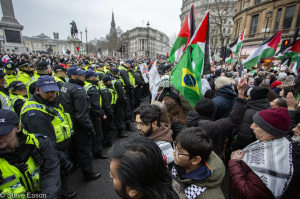
Most importantly. Zohran ran an unapologetically pro-Palestinian campaign, condemning the genocide in Gaza, promising to arrest Netanyahu in accordance with the International Criminal Court warrant. His position on Palestine drove 83 per cent of new voters to vote for him. His stances on immigration, Palestine and what it means to be a global city will set the tone for national politics when there is scant leadership fighting for immigrants and the Palestinian people.
Already, we have heard that his campaign is inspiring leftists in Canada, Mexico and Spain. The terrain is rough, but we will fight for our posture of solidarity.

1 comment
Interesting insights into DSAs organizing! The emphasis on grassroots tactics and internal democracy is inspiring, though the caucuses sound like they could create internal divisions. Useful comparison for activists elsewhere.