

Image:John Walker/Flickr
Stop detention without trial! Stop deportations!
John Walker •Anti-terror laws are being used against the #Stansted15, a group of activists who blocked a charter flight carrying deported migrants out of the country.
On Monday morning, 19 March, first thing, around 200 well-wrapped demonstrators assembled on the steps of Chelmsford Police Station, as a chilly wind whipped around them, freezing our toes, ears and noses. After the speeches were over we moved a few yards down the road to the no-less chilly pavement outside Chelmsford Crown Court.
We we there to support the Stansted 15, a group of people who had been arrested for blocking a charter flight carrying deported migrants out of the country. They are charged not only with aggravated trespass, the usual charge in these sorts of cases, but also with intentionally disrupting services at an aerodrome under the Aviation and Maritime Security Act 1990. This Act was was created in response to the Lockerbie bombing and was intended to deal with terrorism.
It carries a maximum sentence of life imprisonment if the protesters are found guilty.
The trial is simply and straightforwardly a political one. Deportation is a key element in the government’s racist immigration policy, and the trial is intended to intimidate those who oppose this.
The plane had been chartered to carry 57 migrants to Nigeria and Ghana. Many of these, their deportation having been prevented, later appealed, and were released and given leave to remain in Britain.
The detention system
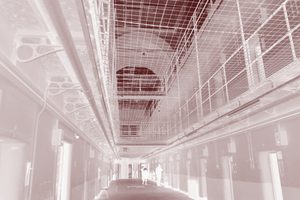
The migrants had all been previously held in Immigration Removal Centres (IRCs). There are ten of these, spread across the UK, including one each in Scotland and Northern Ireland. Over 25,000 people are detained without trial in these centres each year, over two thousand at any given time.
Some of those detained are asylum seekers who are deemed by the authorities to have failed. Others are over-stayers: people who came to the UK legally, with a visa, but at some point failed to renew it. In some cases they have been here for 20 or 30 years and have all their family here.
More than a few of these came as children and didn’t realise that they do not have the right to permanent residence – or even that they were not British citizens. Often parents with a young child regularise their own immigration status and do not realise that this does not cover their offspring. This is far more common than you might imagine.
In additions to these 25,000 there are up to 500 Foreign National Offenders, who are non-British citizens held for deportation each year after serving a prison sentence. Often these sentences are for minor crimes, such as possessing a small amount of cannabis for personal use. Very often these detainees have not been told they will be deported at the end of their sentence and are expecting to be freed when their time is up.
Detainees are held for an indefinite period, Nobody knows when their detention will end. It can last, on occasions, for years. And they can be deported at any time, with little or no notice. Because the authorities use charter flights to fly people out of the country, timings are unpredictable, meaning that family and friends cannot prepare themselves for the removal of their loved ones.

Image:John Walker/Flickr
Whether a migrant is held in an IRC or remains free while their case is being considered is more or less arbitrary. Most people who come to the attention of the Border Police are not detained, and there are no published criteria of whether a migrant should be detained or not. The decision is not made at a tribunal or some such, where evidence is considered, but by an official, many of whom, apparently, are temps, often gap-year students.
The absurd and arbitrary nature of the system can be seen from the figures. Around forty percent of all detainees are released without being deported, giving the lie to government claims that they are in the UK illegally.
The arbitrariness of the detention and deportation systems is part of their intrinsic nature. They are intended to induce a sense of insecurity amongst migrant workers and reducing their self-confidence, making them less likely to fight back against the extreme exploitation they are likely to face in the labour market.
Resistance
But, even within the detention system itself, there is a fightback. On 21st February, 120 women detained in Yarl’s Wood, the IRC for women and families, began a hunger strike against the policy of indefinite detention and a number of other things, including the use of charter flights. You can see a list of their demands on Detained Voices. They have been joined by 14 men from the family wing.
After much difficulty, Diane Abbot, shadow Home Secretary, has been able to meet and talk with them. The Home Office, on the other hand, has not attempted to talk to the hunger strikers but has merely responded by sending a threatening letter to each of them individually.
One of the biggest cheers at the picket of Chelmsford Crown Court was when a message of support for the Stansted 15 from the Yarl’s Wood hunger strikers was read out.
Both struggles need to be supported. The real solution the racism inherent in pitting people form one part of the planet against those from another is the abolition of borders, the ending of the power of states to restrict where people can live and work while allowing capital and profits to flow freely.
Resistance to the system of detention and deportation is a vital step in this process.
- To send a message of support to the Stansted 15 email enddeportations@riseup.net. Follow the campaign on Facebook at https://www.facebook.com/Edeportations/
- For continuing information on the Yarl’s Wood hunger strike, follow Detained Voices on Facebook at https://www.facebook.com/detainedvoices/





1 comment
There is a typo in the article. Five thousand, not five hundred, former prisoners are held in detention awaiting deportation at any one time. Though five hundred is not a small number and is bad enough.