
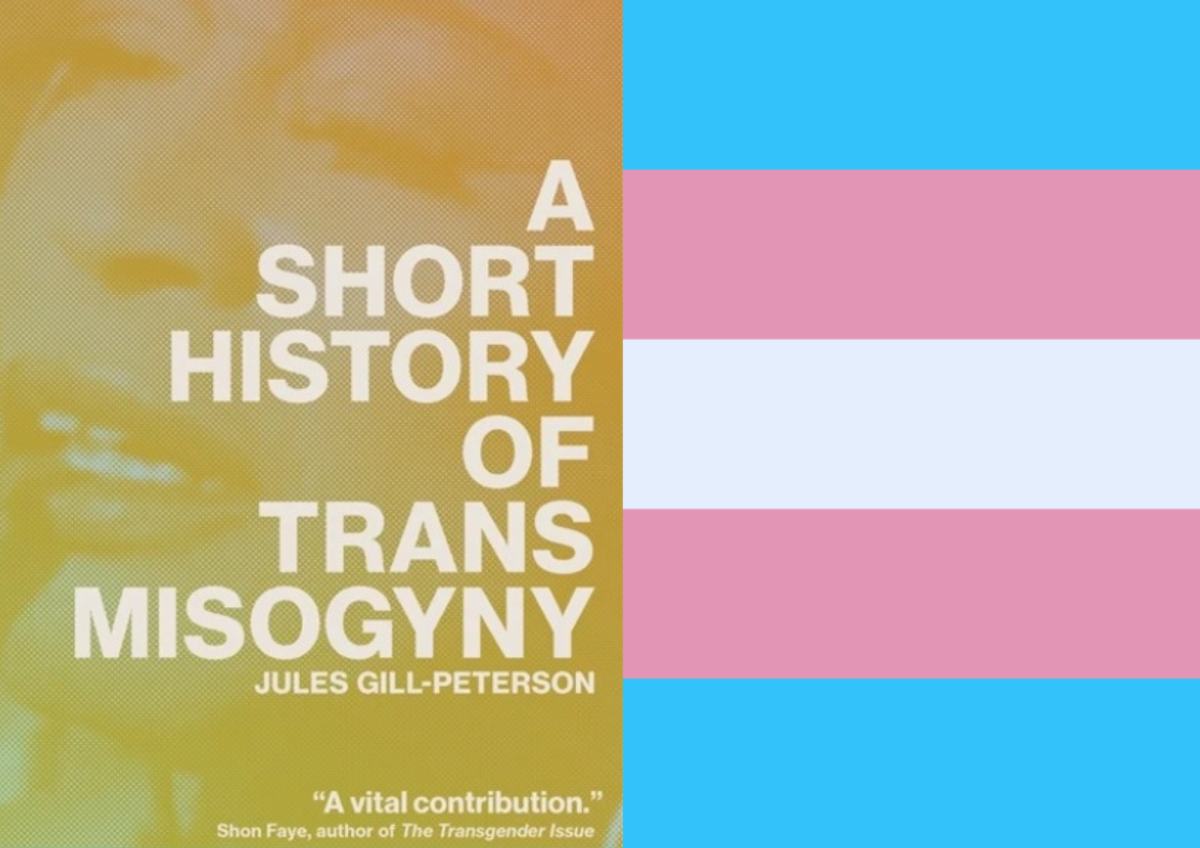
Review | A Short History of Trans Misogyny
Shiraz Hussain •Shiraz Hussain reviews Jules Gill-Peterson’s book, which shows that the trans panic has not always been with us: it was invented
The term ‘trans-misogyny’ posits prejudice against trans women as a form of misogyny. Prejudice against trans women has specific characteristics: it claims that the social recognition of trans women as women poses an existential threat to cisgender women. It claims that gender is immutable and rooted in ‘biology’, without specifying which aspect of biology is being invoked (this claim also targets trans men). Although it frequently claims to be feminist, it is in practice entirely focused on restricting or abolishing the rights of trans women to exist in public spaces, to access services, to have gender-affirming medical care, or to enjoy legal recognition and protection. And anti-trans feminists seem to have little or no problem with making common cause with far-right groups that promote ultra-conservative views on gender roles.
To make the case that this prejudice is a form of misogyny, it needs to be shown that it is based on a view that women are inferior to men.
Gill-Peterson’s focus is on femininity (the cultural expression of femaleness) manifesting where society says it should not: in individuals assigned male at birth. Her subject base — drawn from different societies over a period from the 19th century to the present day — includes, but is not restricted to, trans women.
Her framing differs significantly from the Western liberal approach to transgenderism, which tends to view individuals and, by extension, their gender identities, in isolation from the societies and the historical periods they inhabit.
In contrast, Gill-Peterson’s subjects are historically and socially situated — they are of a particular time and a particular society and their identities are formed by how they survive and earn a living within the limits set by that society. And since they are generally racially and economically marginalised, these people are typically driven into lifestyles that fall outside the boundaries of respectability.
In a further departure from the Western liberal view, Gill-Peterson uses the neologism ‘to transfeminize’ to describe the imposition of the term ‘trans woman’ onto people who are of a period where there is no such category (such as the hijras of India in the 19th century) or who do not so identify (such as the travesti community of Latin America).
The lives examined span a period from the 19th century to the present day and a remarkable array of different communities — the hijras in British India, the ‘two-spirit’ people of First American nations, African-American communities of different historical periods, the street workers’ community of the Stonewall era, trans women in the Philippines, the travestis of Latin America, and many others.
Underlying all this variety and colour is a grim constant: the response — social, political and individual — to this unauthorised, subversive and exuberant femininity.
What is striking is how little this response, and the prejudice that drives it, has changed from the 19th century to the present day: the victim is seen as an intolerable threat to society, is described in dehumanising terms, may face legal sanctions, is frequently threatened, abused and assaulted, and in the worst cases, murdered. The liberalising changes we do see are in the law, but it seems that legal recognition is not social acceptance.
Gill-Peterson locates this prejudice not in individual pathology, but in socially sanctioned opprobrium — individuals are socially cued on the appropriate response to gender transgression so that they can play their part in the policing of gender. We see this in the ‘trans panic’ defense to a murder charge: while the state prosecutes the offender, the offender’s response to finding out that their victim is transgender is generally accepted as a mitigating factor. In other words, it is accepted that the mere fact of the murdered woman being trans posed a threat severe enough to disturb the balance of the offender’s mind.
The author is not a detached or neutral observer — her subjects and their stories, all too often tragic, come to life for the reader, and are not easy to forget. And her protagonists are never simply victims. They are people, fighting not just to survive, but to live their lives fully in the face of a prejudice that seeks to deny their humanity.
From this historical background of rejection and oppression emerges one modern-day grassroots community which has found a different way: the travesti of Latin America. Marginalised not only by their gender expression, but by poverty and racialisation, and left unable to access liberal solutions that depend on having money and fitting into middle-class respectability, these sisters are doing it for themselves. Mutual support networks and unofficial means of obtaining medical help and supplies underpin their lifestyle. They do not identify as transgender, for which the Spanish term is ‘transgenero’. Travesti is travesti. Arguably the central concept among travesti is expressed by the neologism ‘Mujerisima’, formed by adding a superlative to the spanish word for ‘woman’ to express femininity untamed, unapologetic and raised to the highest power. This community, with its challenges to both the strict gender binary of social conservatism and the proposed solutions of liberalism, both of which support the policing of gender by the state, is a crucial referent in this book’s examination of femininity unshackled.
So is transphobia simply a matter of enforcing the ‘appropriate’ gender expression on people who do not identify as the gender they were assigned at birth, or does it incorporate a specific prejudice against trans women? A moment’s thought shows that, while a trans man (at least in western Europe) is generally seen more as an object of curiosity than a threat, a trans woman is in constant danger of exciting the violent hostility described in this book. Gill-Peterson has made her case: not only is prejudice against trans women a form of misogyny, but it is specifically an aversive reaction to femininity.
This interesting, original and well-researched book leaves the reader with a question: what is the nature of the threat posed by unauthorised femininity, a threat so severe that it justifies individual and state violence towards the offender?
It may be helpful to look at the categories associated with the masculine and the feminine in the patriarchal societies in which we live. The masculine is associated with a constellation of concepts to do with social power: dominance in the public sphere, strength, ability, competence, determination, courage and resilience. The feminine is associated with the domestic sphere, with comforting, caring and nurturing, and with roles relating to social reproduction. This is already problematic, but there is something worse, for the feminine is coded as the not-masculine rather than as a category in its own right. So the absence of the prized masculine qualities listed above is coded as ‘feminine’. Women moving into areas where ‘masculine’ qualities are needed frequently feel the need to tone down their femininity, while men who are judged as failing to display these qualities are invited to feel ‘unmanned’ or ’emasculated’, words which have no female equivalents.
The more patriarchal a society is, the more it fears being corrupted and weakened by unregulated femininity, the more it fears being left weak, effete and unable to defend itself. And as a microcosm of the patriarchy, the individual man must do his manly duty and deal with the scourge of femininity appearing where it shouldn’t.
No wonder then that an army of misogynistic men and their female auxiliaries are currently engaged in a determined and extremely well-funded worldwide campaign to exorcise once and for all the spectre that haunts patriarchy, and return us to a better and simpler time when femininity was properly regulated and restricted to child-bearers in traditional marriages. God forbid we should ever have a world where it was enough to simply be human.



0 comments