
What future for Unite the Union?
rs21 members in Unite •Elections have begun for Unite’s ruling Executive Council. rs21 members in Unite argue that they are important for every socialist because they will influence whether Unite orients towards strikes or partnership with employers, whether it seeks to organise workers or just offer them services, whether it remains tied to the Labour Party, and how it approaches issues such as Palestine solidarity and industries such as arms, nuclear and fossil fuels.
Unite’s Executive Council (EC) is made up of ‘lay members’ not employed by the union. Alongside the General Secretary (currently Sharon Graham), the EC determines what sort of union Unite is. Voting papers started being posted out to members on Monday, 23 March, and must be received by Monday 27 April. Socialists should generally support the Back To The Workplace candidates, but the position is not simple.
Bureaucratic factionalism
The election comes after several years of Unite suffering from being highly factionalised between different sections of its staff, each mobilising layers of activists.
Under Len McCluskey, his United Left faction had a comfortable majority on the Executive Council, against a smaller right-wing faction. When he stepped down, United Left supporters backed three different senior union employees: Howard Beckett (who has since been under criminal investigation for bribery, fraud and money laundering), Steve Turner (who has since retired) and Sharon Graham, the former Director of Organising and Leverage, who won. Her main commitments were to strengthen workplace organisation and combativity, clean up alleged corruption, and be more independent from the Labour Party.
During the election, Graham promised to build on the networks brought together in her election campaign, and recognised the importance of them being member-led to keep her accountable. Instead, she continues to rely heavily on her old team in the organising department. Some of her more left-wing supporters (including rs21 members) eventually came together to form the Unite Broad Left, but it rarely meets or does anything in most areas, and its website has been down since 2024.
Meanwhile, Beckett and Turner supporters have regrouped in the United Left and merged with the right-wing Unite Alliance faction to form Members United, supported by most of the Unite officers. The officers are the union’s paid staff who mainly act as intermediaries between workers and employers, whereas the organisers focus on strengthening workplace organisation, campaigns and disputes. Members United are expected to support Simon Dubbins in the General Secretary election later this year. He is a second-generation career bureaucrat historically associated with the right-wing, but who uses his position heading Unite’s international department to pose left on issues far enough from home not to threaten employers or government.
On the outgoing Executive Council, the United Left has been obstructive and destructive, with the union often paralysed by factional conflict between them and Sharon Graham.
The bureaucratic factionalism has led to industrial conflict. When staff in Unite’s National Bargaining and Disputes Support Unit – hired to work on Graham’s agenda and supportive of it – complained of sexism, bullying and victimisation, this was treated as a factional move against Graham and escalated unnecessarily.
Currently, Regional Officers, mostly hostile to Graham, are balloting for a strike over union recognition. The officers, who are members of various unions, had previously decided to be represented through an Officers National Committee (ONC). Now, a potential majority wants to be represented by the Community trade union, which employs several notorious ex-Unite right-wing officials. Sharon Graham claims that Unite is willing to recognise Community, but can’t agree to the ‘sole’ recognition (ending the ONC) they are demanding because of their commitments to recognise members of other unions. It looks like the Regional Officers intend to have strikes to coincide with the General Secretary election.
It is very unhealthy that the election is being framed by both sides as a contest between those loyal to and opposed to Sharon Graham and her own manifesto, rather than about competing visions for Unite or the issues affecting members.
Substantial issues
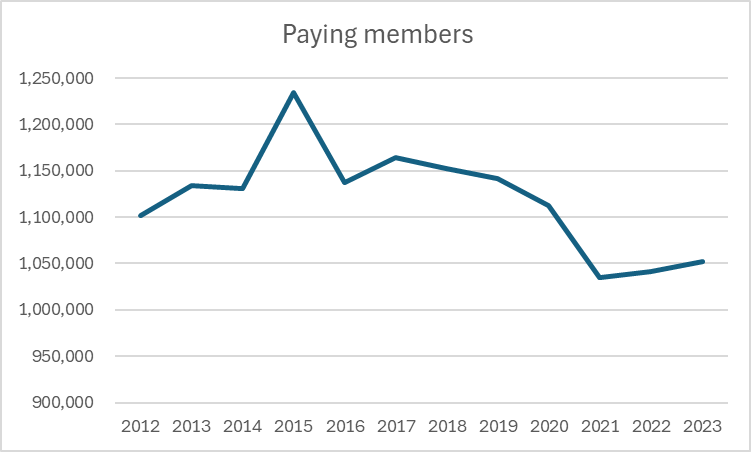
However frustrating it is, the factionalism does connect to real issues. Unite remains plagued with partnership – a focus on shared interests between workers on the one hand and employers and government on the other. Partnership misleads workers and prevents workers using their potential power. In general, the officers are more open to partnership than the organisers due to the nature of their work. Graham’s focus on organising and supporting disputes has helped challenge this in a number of sectors. The annual returns show a slight growth in paying membership since Graham took office in 2021 to 2023 (the last figures published), after several years of decline.
Under Graham, there has been less pressure from officials to settle disputes on bad terms. However, the Birmingham bins dispute has been allowed to drag on with strong support but no clear plan to win, and some major site closures have gone through without real resistance.
Some of Graham’s industrial successes, such as the growth of ‘Combines’ of workplace activists coordinating across particular industries, have been limited by the top-down approach. Worker activists have sometimes been unable to progress the work of Combines without the support of Unite’s organisers, who can get pulled off onto other priorities.
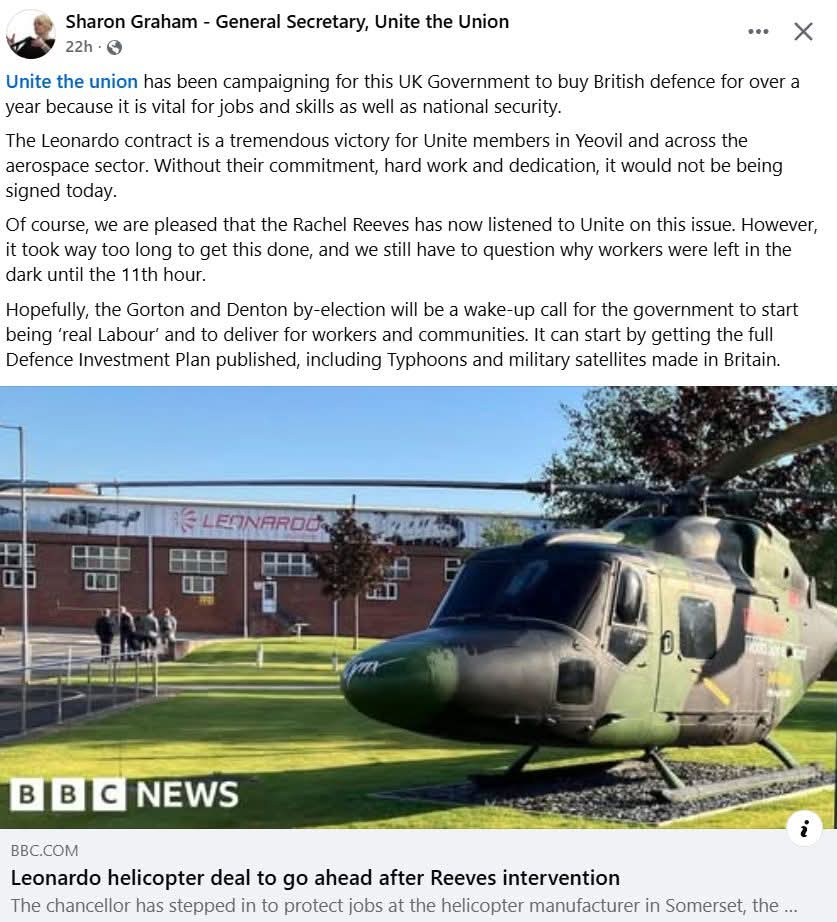
Graham has infuriated many activists with her poor approach to issues, including Palestine solidarity and the fossil fuel and arms industries. When the United Left ran the union, they supported hypocritical fudges – supporting radical sounding policies at conference but supporting the business plans of destructive industries in practice. Graham has replaced this hypocrisy with openly bad positions, counterposing jobs to Palestine solidarity, disarmament and decarbonisation. At times, this has descended into farce, such as concluding from the Green win in Gorton and Denton that Labour should buy more British-made arms.
The ‘no ban without a plan’ campaign has involved little effort to fight for a plan for a just transition, but very vocal campaigning against a ban on new fossil fuels. It took grassroots members, dockers and workers in the arms industry, including rs21 members, to fight for a significant improvement in Unite’s policy on Palestine solidarity. The United Left have been quick to attack Graham from the left on these issues, despite their own track record of partnership with arms and fossil fuel bosses.
Perhaps Graham’s most popular policy has been distancing herself from the sinking Labour Party ship. The main driver for this has been the ongoing Birmingham bin strike, which prompted a re-examination of Unite’s relationship with Labour and, more recently, a big cut in Unite’s affiliation fee. The vote on this at the Executive Council was widely supported, but United Left are clearly much more tied to Labour. The officers are generally more Labour-affiliated than the organisers. A problem with Graham’s approach has been the failure to talk about what replaces the affiliation to Labour. It looks like Graham wants to politically abstain, except where an election can be used as part of a specific industrial campaign. This means she can attract support from the right as well as the left. Reform UK probably has more support among Unite members than any other party at the moment, so there’s no immediate prospect of Unite affiliating to Your Party or the Greens. Socialists should support disaffiliation when it comes up at conference, but push for the adoption of a list of democratically decided policy principles which candidates have to back in order to be considered for union support.
So who should we campaign for?
Both slates include some highly dubious candidates. rs21 members in Unite are critically supporting the Back To The Workplace slate of candidates. However, the creation of the slate by Graham’s team ‘from above’ has meant some candidates worthy of support aren’t on the slate, notably Mark Boothroyd in Health and Nick Troy for Young Members.
The top-down process also led to the inclusion of Kenny Dinsdale, whose previous social media posts backing Tommy Robinson and making homophobic remarks have been exposed. This led to him issuing an apology, claiming they do ‘not represent my views now, were not an accurate representation of my views at all’ and that ‘I have changed my perspective as life has gone on and the environments I have been part of have altered’. He said, ‘I believe in a Union … that defends all workers regardless of their race, religion or sexuality – unity has no place for division of any kind’. The fact that he said nothing about this until challenged and hasn’t explained his views or how they have changed leaves a lot of questions unanswered.
The election rules and the full list of candidates and their statements can be found online. Turnout in these elections is usually very low, so all attempts to engage members and campaign are valuable. You can talk to people you know in Unite about the elections, leaflet Unite workplaces, raise money towards election costs and invite candidates to your workplace or meeting.
Useful links:
- Back To The Workplace slate
- Election rules
- Jules and Ray, standing for the Scotland seats
- Mark Boothroyd for Health
- Nick Troy for Young Members

0 comments