

Tate workers on strike
Alys Stretton •Workers at Tate have taken strike action against below-inflation pay and job losses. Alys Stretton reports.
As state funding for culture continues to slowly collapse under successive austerity governments, the sector is experiencing ructions. The government’s Autumn Budget offered nothing to reverse the year-on-year cuts. Their fix is to instruct cultural organisations that have long depended on state funding to fill gaps through developing private streams of income.
Where private revenue is not being generated quickly enough to balance organisational finances, the general outcomes are staff cuts, shrinking pay and the depletion of public service provision. The workers have an answer that rejects the austerity premise. They are refusing to allow private capital greater control over cultural production, or to let public resources wither away. Instead, they are fighting to secure what they need to do their jobs and live their lives.
The strike
Staff at Tate galleries took seven days of strike action after being offered a below-inflation pay rise for the second consecutive year. PCS, the public sector service union representing gallery staff, turned out a ballot of 87.7 per cent, with 98 per cent voting in favour of strike action. Contributing factors to the sense of disquiet are the downgrading of staff pensions, a 7 per cent staff redundancy hit earlier this year, and the institution’s obstinate refusal to meaningfully respond to the genocide in Palestine despite persistent calls from inside and outside the organisation. Tate management also closed down the subsidised staff canteen, which seems like a counterproductive decision given the link between hunger and anger. Workers are demanding an inflation-proof pay rise in line with the Retail Price Index, pay restoration for last year’s shortfall, paid lunch breaks and double pay for weekend shifts. When you look at what they’ve lost, these are modest demands.
Over 150 workers took part across Tate’s five sites with picket lines at Tate Britain, Tate Modern and Tate Liverpool. On the final strike day, around 150 staff and supporters protested in front of the iconic post-industrial Tate Modern building, wrapping up the seven days of ‘strength and creativity’ with a trip to the pub.
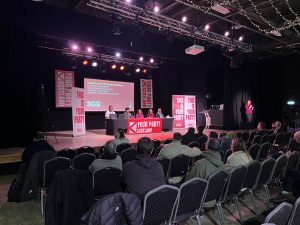
Support extended beyond staff. Freelance artists refused to cross the picket line by cancelling their work appointments at the gallery. Turner prize winners and high profile politicians attended pickets with messages of support, helping the strikes win further positive media coverage. Artists in Liverpool ran a wildly successful strike fundraiser event for their sector comrades. A branch representative at National Museums Liverpool raised £400 for Tate strikers at the Your Party conference.
The strike also highlighted solidarity with Palestine. Activists gathered at Tate Britain on Saturday 29 November and Tate strikers joined chants for Palestinian freedom during the International Day of Solidarity with Palestine. These activities might be seen as an exemplary use of the strike as a form of protest – developing political alliances with wider communities and sections of the working class.
Throughout the dispute, ‘Tate United PCS’, an Instagram account set up during an industrial dispute at Tate in 2020, has been broadcasting updates from the strike. Now with over 10,000 followers, it can claim to be the most prolific social media account for any single trade union branch in Britain. Despite all of the public and cross-class support, these strikes have only been able to partially shut down Tate’s operations, with visitors still being welcomed into most public parts of the building on the strike days. Not all of the staff were eligible to strike. Some front of house staff are employed through an external agency rather than by Tate directly and are therefore not part of the PCS union’s bargaining unit, curtailing their ability to join the strike. Many other members of staff are represented by a different union, Prospect, whose Tate branch voted to accept the below-inflation pay offer (51 per cent in favour on a remarkably low turnout), rather than balloting members to strike.
Some Prospect members chose to leave and join PCS. Earlier this year, Prospect lost a lot of members at the Royal Academy, following dissatisfaction with its handling of mass redundancies. Over the past two months at the British Library, PCS members have engaged in two rounds of strike action, while library staff in Prospect have continued going to work. With regard to the British Library, Prospect officials controversially claimed that a somewhat improved pay offer has been the result of their own negotiations rather than the effect of a strike carried out by PCS members. If Prospect cannot rise to the challenge and organise a strike, then the only option for workers will be to join other unions, as they have been doing at Tate.
Cracks in the Turbine Hall
Government funding has not kept up with inflation, leaving the culture sector effectively defunded. The slack is not being made up for through private philanthropy and nor should it be. If there was a pinnacle moment of disgrace for the publicly funded arts sector in 2025, it was when a letter called for leniency around accepting money from boycotted corporations. Castigating the ‘relentless negativity’ of protestors, the missive had been signed by the directors of 11 high-profile cultural institutions. As Ellen Ormesher and Kathryn Clare’s investigation was brought to light, this letter was drafted by Brunswick Group, a PR company that has spent years cleaning up the image of fossil fuel companies.
When it comes to properly funding the sector, art institutions need to make it absolutely clear to the government what the stakes are in terms of retaining staff and maintaining the quality of the social value that we provide to the public. Some creative industry leaders have reported that they are ‘disappointed’ by the Autumn Budget. A larger number of workers are beginning to express this feeling more strongly through organising and industrial action.
In 2020 the Turner Prize winner Mark Leckey stood on the picket lines outside the Tate Modern and compared the situation to Colombian artist Doris Salcedo’s 2007 installation Shibboleth in the Turbine Hall. The brutal 167- metre long crack embedded into the building’s concrete floor represented how it’s ‘them’ on one side of the art world and ‘us’ on the other. Today, as workers organise against a political and artistic establishment that is pressuring us into ceding control to corporate interests, the fracture appears severe. A unionised workforce is a safer workforce and through collective action, we are showing that culture can be defended. There is much at stake, and, as ever a world to win.






0 comments